LONGi, the pioneer in back-contact (BC) solar technology, has officially released technical performance data for its Hi-MO X10 series, revealing a breakthrough in shading resilience. By leveraging proprietary “Soft-Breakdown” physics, the Hi-MO X10 recovers up to 70% more power than traditional TOPCon modules in partially shaded environments—a critical advancement for the MENA region’s high-soiling and dense urban landscapes.
The Physics of “Soft-Breakdown”
Standard PV modules utilize a “Hard Breakdown” mechanism. When a single cell is shaded by sand, a chimney, or a bird, it creates a massive electrical bottleneck. To prevent the cell from overheating and catching fire, an external bypass diode triggers, shutting down an entire third of the module (one cell-string). This results in a 33% power loss for a shadow covering less than 1% of the panel.
The Hi-MO X10, powered by HPBC 2.0 (Hybrid Passivated Back Contact) technology, utilizes an internal “Soft-Breakdown” design.
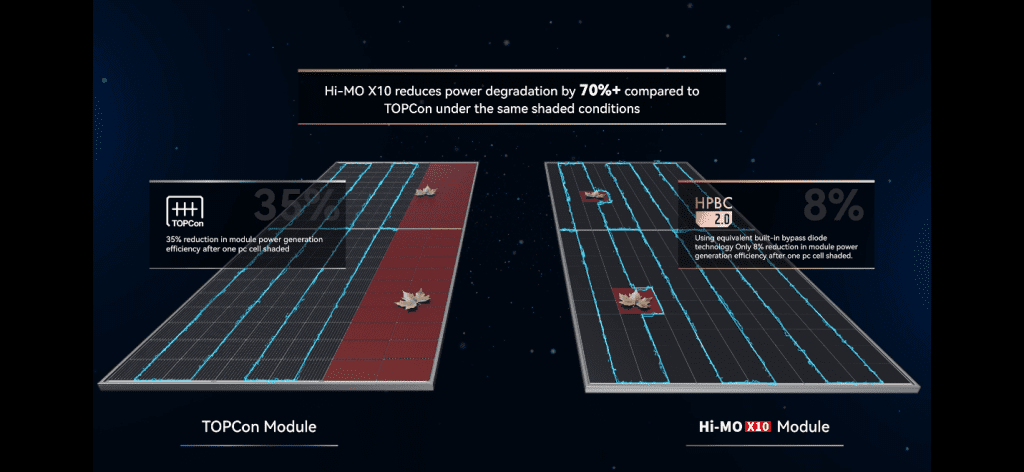
Internal Shunting: Rather than shutting down the whole string, the HPBC 2.0 cell acts as a pressure-relief valve. It allows current to autonomously “leak” through the shaded cell at a lower voltage.
Continuous Generation: This prevents the external bypass diode from ever being triggered, allowing the remaining 99% of the string to continue generating power at peak capacity.
Validated Thermal Safety: A 90C° Difference
In high-ambient temperatures like those found in Saudi Arabia and the UAE, shading-induced hotspots are a leading cause of module failure. Traditional TOPCon modules under shading can reach “Hard Breakdown” temperatures exceeding 160C°, threatening the structural integrity of the backsheet and glass.
In a ‘Hard Breakdown’ (TOPCon), the cell is forced to dissipate massive amounts of energy in a tiny area, leading to permanent lattice damage and ‘snail trails.’ In LONGi Soft-Breakdown design, the energy is distributed across the entire PN junction area of the HPBC cell. Because the temperature stays below 90C°, the silicon remains well within its safe operating window, ensuring the 88.85% power guarantee at Year 30 is fully achievable.
The Hi-MO X10’s Soft-Breakdown circuitry keeps the shaded area at a safe operating temperature—typically under 80C°. These 80\ 90 degrees temperature gap significantly reduces thermal stress, micro-cracking, and fire risks, making it the most reliable choice for rooftop and large-scale desert installations.
How it works:
Back-Contact Architecture: Because all electrical pathways are on the rear, LONGi engineers have integrated a “weak conduction” pathway within the cell structure itself.
Autonomous Rerouting: When a cell is shaded, the HPBC 2.0 structure allows the current to autonomously bypass the individual shaded cell at a lower voltage threshold.
Localized Impact: Instead of losing 33% of power (a full string), the Hi-MO X10 limits the loss to only the shaded area.
Evidence of Superiority: 70% Less Power Loss
Recent laboratory tests and TÜV Rheinland Class A certifications have validated these results:
Power Retention: Under partial shading (e.g., a single cell 50% shaded), the Hi-MO X10 retains approximately 92% of its output, whereas a standard TOPCon module’s output typically drops to 65% or lower.
Hotspot Mitigation: Traditional modules under shadow can reach temperatures of 160C, creating a fire risk. The Hi-MO X10’s soft-breakdown design ensures localized temperatures remain under 80C, drastically extending the module’s lifespan in the harsh MENA heat.
A Masterclass in Reliability
Certified “Three-Proof” Performance
The Hi-MO X10 is the first module to earn the CPVT ‘Three-Proof’ Certificate, verifying its superior resistance to Fire, Dust, and Shading.
“In the MENA region, shading isn’t just an inconvenience; it’s a financial and safety risk. “By re-engineering the cell at the PN-junction level, LONGi has created a panel that manages shadows internally. It’s not just a smarter panel; it’s a safer investment.”