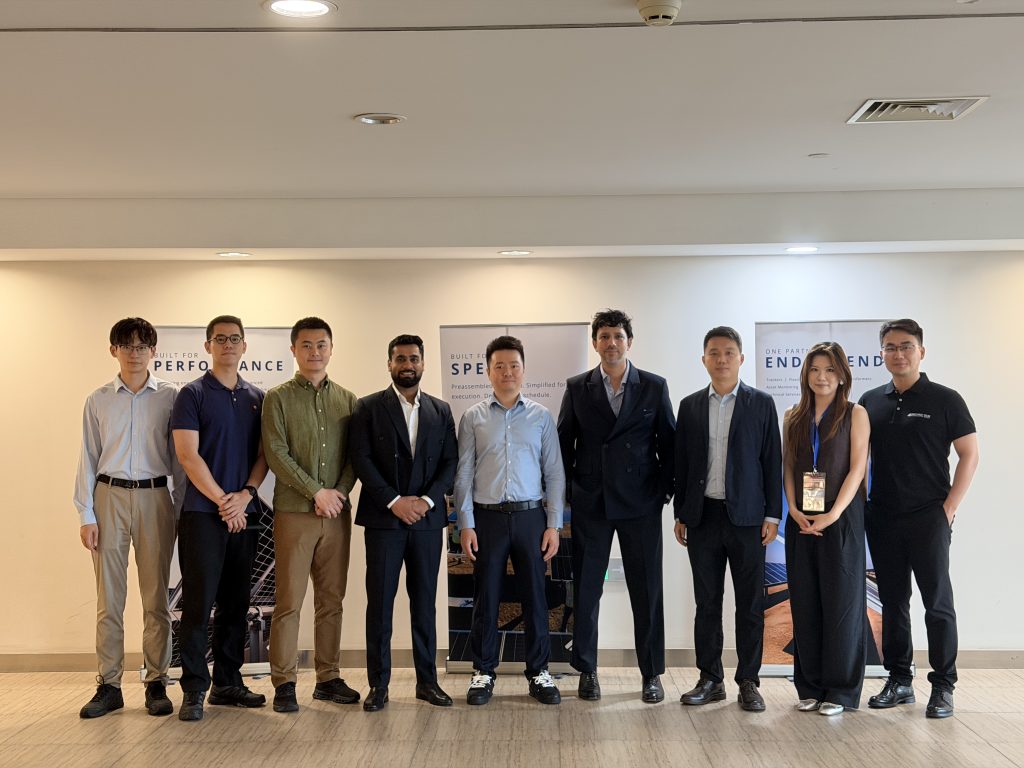
- What were GameChange Energy’s key takeaways from SNEC 2026, particularly around tracker demand in the MENA region?
One of the most noticeable themes at SNEC this year was how the conversation around utility-scale solar continues to evolve. A few years ago, discussions were largely centred on capacity additions and equipment selection. Today, developers, EPCs, lenders and asset owners are spending much more time looking at long-term project performance, reliability and overall project value.
We saw strong interest in topics such as wind resilience, tracker behaviour during extreme weather events, digital monitoring and controls, construction efficiency, and technologies that can improve energy yield over the life of an asset. These discussions were particularly relevant for the MENA region, where projects are growing in scale and are often being developed in some of the world’s most demanding operating environments. We saw growing interest from markets such as Saudi Arabia, the UAE and neighbouring countries, with customers placing increasing emphasis on proven performance under high winds, extreme temperatures and desert conditions.
Another clear takeaway was that customers are increasingly evaluating technologies as part of a complete project solution rather than in isolation. Whether the discussion was around trackers, power infrastructure or controls, the focus was consistently on how different technologies interact to contribute to overall plant performance. That aligns closely with our view at GameChange Energy that project success is driven not by individual components alone, but by how those technologies are integrated to support construction efficiency, operational reliability and long-term asset performance.
- Large projects in Saudi Arabia and the wider region face high wind, heat, and desert conditions. How do tracker technologies need to adapt to these environments?
Projects in MENA require tracker systems that are engineered specifically for the realities of the region rather than adapted from milder climates. High wind events, extreme temperatures, shifting wind directions, sandstorms, and large-scale desert deployments all place unique demands on tracker structures and control systems.
The industry’s focus is increasingly on resilience. This means robust structural design, advanced wind-response strategies, site-specific engineering, and systems capable of maintaining performance over decades of operation. It also means designing for terrain variability, geotechnical conditions, and long-term durability under continuous thermal and environmental stress.
As project sizes reach gigawatt scale, reliability becomes just as important as energy production because even small performance improvements can translate into significant economic value over the life of the asset.
- How do features such as smart stowing, terrain adaptation, and performance optimization affect long-term project returns?
These capabilities have a direct impact on project economics.
- Smart stowing helps protect assets during high-wind events while maximizing operational uptime, reducing the risk of structural damage and costly repairs.
- Terrain adaptability allows developers to utilize more challenging sites while minimizing grading requirements, reducing civil costs and accelerating construction schedules.
- Performance optimization technologies improve energy capture, increase system availability, and support more consistent generation profiles throughout the life of the project.
When viewed over a 25- to 30-year project life, these benefits can significantly improve project IRR through higher energy production, reduced operational risk, lower maintenance costs, and improved asset availability. The industry is increasingly recognizing that tracker selection should be based on total lifecycle value rather than upfront equipment cost alone.
- As MENA projects scale up, what should developers consider earlier in the design stage when selecting tracker systems?
The most successful projects consider tracker selection much earlier in the development process. Developers should evaluate:
- Site-specific wind and environmental conditions
- Designing with uplift scenario (since lot of OEMs are reducing the designing wind speed and designing for potential failure)
- Terrain characteristics and grading requirements
- Geotechnical constraints
- Module compatibility
- Construction methodology and installation speed
- Long-term operations and maintenance requirements
- Integration with power infrastructure and monitoring systems
A key takeaway from discussions at SNEC was that project stakeholders are increasingly evaluating the entire project lifecycle rather than individual equipment packages. Early collaboration between developers, EPCs, and technology providers can unlock meaningful savings in both CapEx and OpEx while improving long-term performance.
- Looking ahead, what are GameChange Energy’s expectations for the MENA solar market, and how do you see your role in supporting its next phase of growth?
We expect MENA to remain one of the world’s most important utility-scale solar markets over the coming decade. The combination of strong solar resources, ambitious clean energy targets, and large-scale infrastructure investments will continue to drive significant growth across Saudi Arabia, the UAE, Egypt, and other regional markets.
As projects become larger and more sophisticated, the market will increasingly demand partners that can support not only tracker deployment but also broader project infrastructure, controls, and long-term performance optimization. This is one of the reasons behind the evolution toward GameChange Energy, bringing together trackers, transformers, eBOS, and asset monitoring under a unified platform. The objective is to help developers simplify project execution, reduce risk, and maximize performance throughout the entire project lifecycle.
Our role is to continue delivering solutions specifically engineered for challenging environments, while helping customers build the next generation of resilient, high-performing utility-scale solar projects across the region.